Compressed Biogas: Turning India’s Waste Challenge into a Clean Energy Opportunity
India’s organic waste is an untapped ~USD 51 billion market opportunity that can create 26 lakh direct jobs and offer a sustainable alternative to fossil fuel dependency.
The transportation, electricity, heating, and industrial processes in India largely draw upon energy derived from sources such as coal, petroleum, and natural gas. These sources are derived from fossil fuels, making them a non-renewable source of energy. As compared to solar, wind, biomass, and bioenergy, which are renewable sources of energy.
With India importing 88.5% of its crude oil and 50% of natural gas to meet its fuel requirements and having a projected increase of almost 1.2 million barrels/day, using non-renewable sources of energy as the primary source of fuel is no longer a sustainable option.
India’s domestic production of crude oil and natural gas accounts for only 13% of the current supply needs. Waste-to-wealth conversion is an environmental and economic necessity for India. If India could utilise 95% of its urban organic municipal waste through a balanced mix of composting and biomethanation, the country could reduce its net carbon emissions by ~68 million tonnes by 2047!
This blog presents compressed biogas as a sustainable homegrown alternative that is both a renewable biofuel and has equivalent methane properties to natural gas.
What is Compressed Biogas (CBG)?
Waste residues such as agricultural waste, municipal solid waste, sewage treatment plant waste, etc. naturally produce biogas through the process of anaerobic (without oxygen) decomposition. However, this form of raw biogas contains approximately 55% to 60% methane, 40% to 45% carbon dioxide and trace amounts of hydrogen sulphide, which if left untreated can cause significant health and environmental problems.
A globally popular alternative to dealing with large-scale biomass waste from paddy straw, press mud from the sugar industry, cattle dung, poultry litter, rotten vegetables from cold storage, dairy plants, horticulture waste, and forestry residues has been to convert it as feedstock for CBG.
| Key Terminology | Meaning |
|---|---|
| Biomass/feedstock | Organic material used as input for CBG production |
| Biogas | Gas produced through anaerobic digestion of biomass |
| Methane | A biogas component that works as a sustainable biofuel |
| Upgrading | Removing CO₂ and impurities from biogas |
| CBG | Purified, compressed biomethane renewable fuel alternative |
| Fertilizer | Residue from biofuel production, rich manure and enhances soil potential |
From Biomass to Biogas, How CBG is Made
Minimally treated raw biogas due to its composition can be used as a cooking fuel or for power generation. It cannot, however, be used as fuel for vehicles unless cleaned and upgraded to CBG. This process requires introducing cleaned biomass to an anaerobic digester in a controlled environment without oxygen to ensure the microorganisms naturally break down the particles. The raw biogas produced is further purified by removing carbon dioxide, water vapour, and hydrogen sulphide gases before compressing it to prepare CBG. Moisture and hydrogen sulphide are removed from the biogas to ensure that no engine corrosion or compressor damage occurs when CBG is used as a fuel in automobiles.
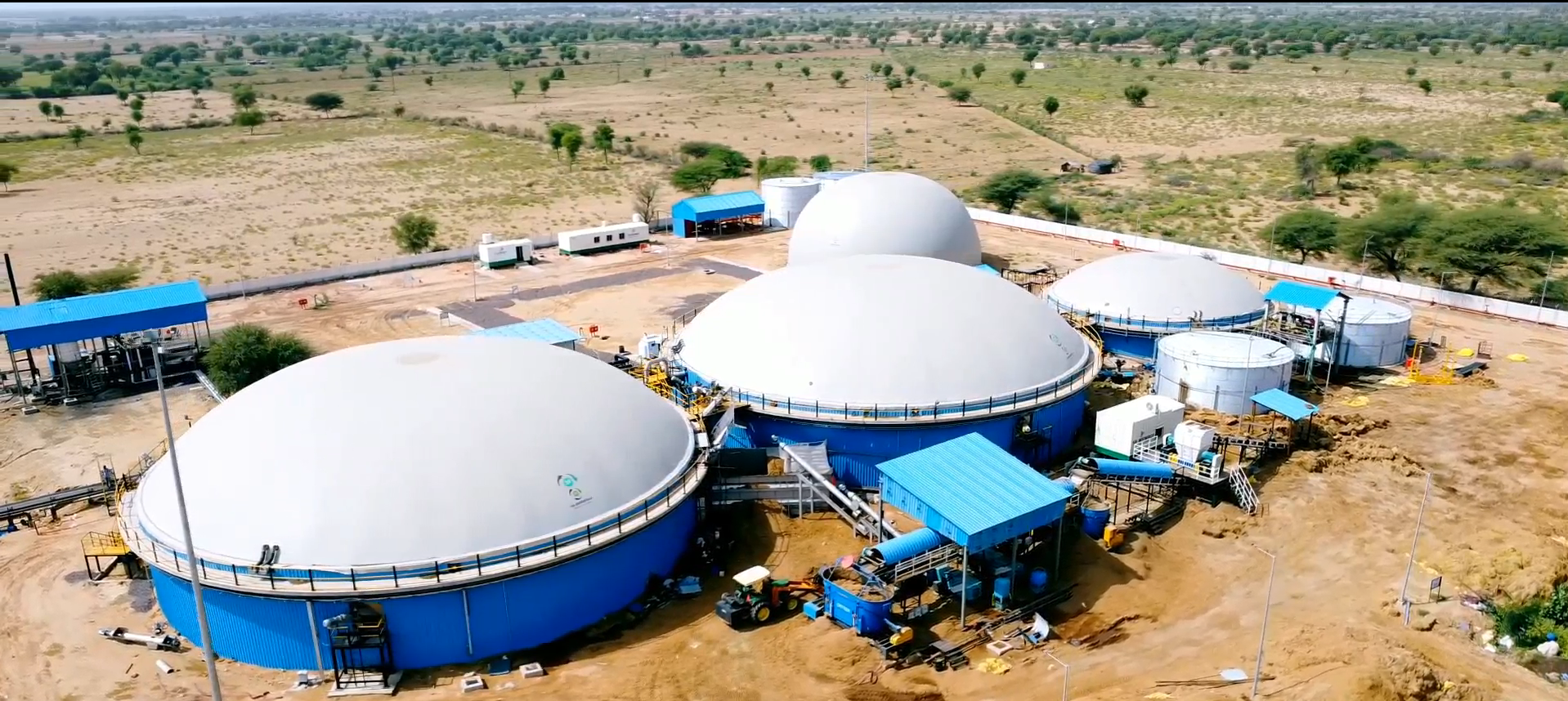
As a result, compressed biogas can only be produced in large-scale CBG plants in a supervised manner to ensure safety, minimal environmental impact, and quality control of the by-product. A CBG plant like Sai Bioenergy’s plant in Bikaner, Rajasthan, has the potential to produce 10 tonnes of CBG per day and sources more than 31,000 tonnes of biomass annually.
Crops such as Napier grass, maize, and sorghum work as great energy crops for CBG production in such plants. These energy crops store carbon dioxide from the atmosphere while growing and solar energy in their biomass, which can be converted into fuel. Their fuel conversion process produces organic manure as a by-product that in turn can be used as fertilizer by crops.
Sai Bioenergy utilises the 3F-Model: Feedstock, Fuel, and Fertilizer to operate on circularity. The organic waste and by-products from the plant’s biofuel production are recycled as fertilizer, establishing a sustainable closed-loop system.
While CBG can be manufactured from agricultural residue, organic municipal waste and animal waste like cow dung, Sai Bioenergy uses select high methane content feedstock like Paddy Straw and Energy Crops like Napier Grass, Biomass Sorghum and Maize stalks.
Rethinking Waste as Energy
Understanding the Scale of India’s Waste Production
The majority of India’s organic waste currently decomposes in landfills, releasing toxic greenhouse gases, odours, and methane that accelerate environmental degradation through soil, water, and air pollution and lead to significant health problems.
India currently generates ~171,000 tonnes of municipal solid waste every day, and this is projected to reach ~208 million tonnes annually in urban cities by 2047. 80% of the waste generated is left in landfills due to poor segregation and improper waste management.
However, 40-60% of the waste is organic waste, which, if purified and utilised appropriately, can be converted into biofuel and solve our growing waste management problems and reduce dependency on fossil fuels.
The Journey from Feedstock to Renewable Fuel
With access to high amounts of organic waste, India’s waste management focus has shifted towards the use of CBG as a cleaner solution to a multifaceted problem. However, it is important to note that not all organic waste can serve as feedstock for CBG. The organic waste composition directly impacts the biofuel production and quality.
The amount of total solid present and the portion of volatile solids (ability to be broken down by microorganisms), among other factors, determine the biodegradability of the feedstock. Feedstock with higher biodegradability produces greater amounts of raw biogas, resulting in higher CBG quantities.
While minimally treated biogas can be combusted to produce electricity in stationary engines, fuel in large-scale vehicular usage must meet the quality thresholds and methane standards set by the government of India and enforced through the SATAT mission.
How India’s organic resources and waste can become fuel, fertilizer, and economic value for the country
With fossil fuel energy sources becoming increasingly more expensive and unhealthy for the planet, India’s Ministry of Petroleum and Natural Gas launched the Sustainable Alternative Towards Affordable Transportation (SATAT) Scheme in 2018. The aim was to promote production and utilisation of CBG as an alternative to traditional fossil fuels and increase India’s natural gas usage from 6.7% to 15% by 2030. GOI has also introduced the Compressed Biogas-City Gas Distribution (CBG-CGD) Synchronisation Scheme managed by GAIL India Limited to blend renewable biogas into city natural gas networks at Uniform Base Price (UBP).
Did you know?
According to the Ministry of New and Renewable Energy, the current agricultural waste in India has the potential to generate over 18,000 MW of power annually. To understand this in context, this amount of power can charge around 2.57 million electric vehicles simultaneously or power 18-27 million households in the country!
How CBG turns organic waste and agricultural residue into a domestic source of clean energy
Purified and compressed biogas is not only a more sustainable alternative, but with more than >=95% methane content, it is similar to the commercially available natural gas (CNG). It additionally shares similarities in composition, energy potential, calorific value, and other properties, making CBG a commercially sustainable fuel and an eco-friendly alternative to CNG across automotive, industrial, and commercial applications.
Comparison of CBG and CNG
| Parameter | Sai Bioenergy Bio-CNG (CBG) | CNG (Compressed Natural Gas) |
|---|---|---|
| Source | Produced from organic waste (Napier Grass, paddy etc.) | Extracted from natural gas reservoirs |
| Main Component | Methane (≥98%) Unparalleled market purity | Methane (typically 90–96%) |
| Compression Pressure | ~200–250 bar | ~200–250 bar |
| Composition | CH4(98.542%), CO2(1.348%) N2(0.1159) O2(0.011%) | C1(92%) C2(6%) C3(1%) IC4(0.14%) NC4(0.19%) IC5(0.013%) NC5(0.089%) C6+(0.012%) N2(0.236%) CO2(0.23%) |
| Density (Kg/m3) | 0.696 | 0.730 |
| Molecular weight(g/mol) | 16.434 | 17.24 |
| Calorific Value (Kcal/Kg) | Comparable to CNG when meeting BIS standards IS 16087:2025 | Standard reference fuel, 12500 |
| Vehicle Compatibility | Fully compatible with CNG vehicles | Designed fuel |
| Pipeline Compatibility | Yes | Yes |
| Storage & Dispensing | Same cylinders, cascades, dispensers | Same infrastructure |
| Renewable | Yes | No (Fossil fuel) |
| Carbon Footprint | Very low / Carbon-negative potential | Lower than petrol & diesel but fossil-based |
CBG: A Singular Solution to a Multifaceted Problem
The convenience and adaptability of use makes compressed biogas an economic opportunity that improves energy supply, mitigates the effect of climate change and reduces greenhouse gas emissions in addition to paving the way for rural development and employment opportunities.
- Serves as an additional source of revenue for farmers
- Promotes rural employment and development
- Serves as a sustainable waste management avenue for agricultural waste residue, cattle dung, municipal solid waste, and kitchen waste.
- Reduces India’s dependency on imported fossil fuels and acts as a buffer in case of oil/gas surge pricing
- Enables India’s pledge to achieve climate change goals
- Reduces carbon emissions and pollution levels
To read more such insights on Renewable Biofuels and Energy Storage Solutions, explore our insights.